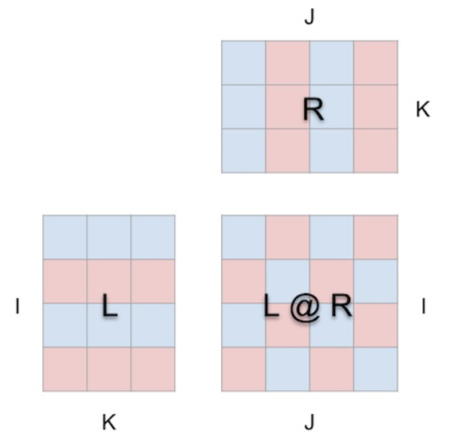
PyTorch의 matmul(), mm(), bmm()
PyTorch에서 행렬 곱셈(Matrix Multiplication)을 수행하는 대표적인 함수는 다음 세 가지임.
torch.matmul()
torch.mm()
torch.bmm()
세 함수 모두 행렬 곱셈을 수행하지만, 입력 Tensor의 차원과 Batch Dimension의 처리 방식에 차이가 있음.
개인적으로 범용으로 사용가능한
torch.matmul을 선호.
https://dsaint31.tistory.com/725
[LA] Matrix-Vector Multiplication
Matrix-Vector MultiplicationLinear TransformMatrix와 vector의 곱은 일종의 Linear Transformation으로 볼 수 있음.곱해지는 Vector를 Matrix가 나타내는 Linear Transformation 처리하는 것으로 볼 수 있음.Matrix $A$ 와 vector $\ma
dsaint31.tistory.com
1. torch.matmul()
Signature
torch.matmul(input, other, *, out=None) → Tensor
Tensor Method 형태:
input.matmul(other)
out은 연산 결과를 저장할 출력 Tensor를 미리 지정하는 선택적 매개변수임.
- 기본값이
None이므로, 별도로 지정하지 않으면 PyTorch가 결과를 저장할 새로운 Tensor를 생성함. - 지정할 경우, 해당 Tensor 객체의 메모리에 결과를 저장.
- CPU Tensor 연산 결과를 CUDA Tensor에 저장하려는 경우는 적절하지 않음.
- 가급적 결과 shape 를 만족하는 텐서를
out으로 해야 함.
다음은 간단한 실행 예제임:
A = torch.randn(2, 3)
B = torch.randn(3, 4)

C = torch.matmul(A, B)
반면 다음과 같이 출력 Tensor를 미리 지정할 수도 있음.
C = torch.empty(2, 4)

torch.matmul(A, B, out=C)
이 경우 연산 결과가 이미 존재하는 C에 기록됨.
즉,
out은
결과를 저장할 메모리 공간을 지정하는 옵션임.
특징
matmul()은 입력 Tensor의 차원에 따라 동작이 달라지는 가장 널리 사용되는 행렬 곱셈 함수 임.
| input 차원 | other 차원 | 동작 |
| 1D | 1D | 벡터 내적 |
| 2D | 2D | 행렬 곱 |
| 1D | 2D | 벡터와 행렬의 곱 |
| 2D | 1D | 행렬과 벡터의 곱 |
| ND | ND | Batch Matrix Multiplication + Broadcasting |
1.1 1D × 1D: Vector Inner Product
내적으로 동작함.
a = torch.tensor([1., 2., 3.])
b = torch.tensor([4., 5., 6.])

y = torch.matmul(a, b)

print(y)
결과:
tensor(32.)
계산은 다음과 같음:
$$
1 \times 4 + 2 \times 5 + 3 \times 6 = 32
$$
- 1D Tensor끼리
matmul()을 수행하면 Vector Inner Product가 됨.
1.2 2D × 2D: Matrix Multiplication
A = torch.randn(2, 3)
B = torch.randn(3, 4)

C = torch.matmul(A, B)

print(C.shape)
결과:
torch.Size([2, 4])수학적으로는 다음과 같음:
$$
(2 \times 3)(3 \times 4) = (2 \times 4)
$$
1.3 3D × 3D: Batch Matrix Multiplication
뒤의 2개 축을 제외한 나머지들은 batch를 구성!
A = torch.randn(10, 2, 3)
B = torch.randn(10, 3, 4)

C = torch.matmul(A, B)

print(C.shape)
결과:
torch.Size([10, 2, 4])
각 Batch에 대해 독립적으로 행렬 곱셈을 수행함:
$$
C_i = A_iB_i
$$
즉, 다음이 성립:
A : (10, 2, 3)
B : (10, 3, 4)
C : (10, 2, 4)
1.4 matmul()의 Broadcasting
matmul()은
행렬 차원(Matrix Dimensions)을 제외한 Batch Dimensions에 일반적인 PyTorch Broadcasting 규칙을 적용함.
다음의 예를 참고:
A = torch.randn(10, 2, 3)
B = torch.randn(3, 4)

C = torch.matmul(A, B)

print(C.shape)
결과:
torch.Size([10, 2, 4])
B에는 Batch Dimension이 없으므로 모든 Batch에 공통으로 사용됨.
개념적으로는 다음과 같음.
for i in range(10):
C[i] = A[i] @ B- 실제로 Python Loop를 수행한다는 의미는 아님(같은 결과를 내지만, 병렬로 처리됨)
- Broadcasting을 통해 동일한 행렬이 각 Batch에 적용됨.
Batch의 Dimension 이 Broadcasting이 안되는 shape인 경우엔 동작안함.
다음의 예를 실행해볼 것:
A = torch.randn(10, 2, 3)
B = torch.randn(5, 3, 4)

C = torch.matmul(A, B)
batch의 10과 5는 Broadcasting 규칙을 만족하지 않음.
matmul()은
Batch Dimension에 Broadcasting을 지원하지만,
Broadcasting 규칙을 만족하는 경우에만 적용됨.
2. torch.mm()
Signature
torch.mm(input, mat2, *, out=None) → Tensor특징
torch.mm()은 2D Tensor와 2D Tensor의 행렬 곱만 지원함.
입력 형태:
(m, n) @ (n, p)
출력 형태:
(m, p)
즉, 다음의 수식을 구현하고 있음:
$$
(m \times n)(n \times p) = (m \times p)
$$
기본 사용법
A = torch.randn(2, 3)
B = torch.randn(3, 4)

C = torch.mm(A, B)

print(C.shape)
결과:
torch.Size([2, 4])mm()은 Broadcasting을 지원하지 않음
mm()은 2D × 2D만 허용함
- Batch Dimension을 포함하는 Tensor는 사용할 수 없음.
다음과 같은 ndim=3인 경우는 아예 동작안함:
A = torch.randn(10, 2, 3)
B = torch.randn(3, 4)

torch.mm(A, B)
mm()은
Batch Matrix Multiplication을 수행하지 않음.
3. torch.bmm()
Signature
torch.bmm(input, mat2, *, out=None) → Tensor
특징
torch.bmm()은 3D Tensor끼리의 Batch Matrix Multiplication을 수행함.
입력 형태:
(b, m, n) @ (b, n, p)
출력 형태:
(b, m, p)
즉, 다음의 수식을 구현하고 있음:
$$
(b,m,n)(b,n,p) \rightarrow (b,m,p)
$$
기본 사용법
A = torch.randn(10, 2, 3)
B = torch.randn(10, 3, 4)

C = torch.bmm(A, B)

print(C.shape)
결과:
torch.Size([10, 2, 4])
Batch의 각 요소별로 독립적인 행렬 곱을 수행.
C[0] = A[0] @ B[0]
C[1] = A[1] @ B[1]
...
C[9] = A[9] @ B[9]bmm()은 Broadcasting을 지원하지 않음
다음의 예를 실행해 볼 것:
A = torch.randn(10, 2, 3)
B = torch.randn(1, 3, 4)
Batch Dimension은 다음과 같음.
A : (10, 2, 3)
B : ( 1, 3, 4)10과 1은 일반적인 Broadcasting 규칙에 따라 Broadcasting 가능함.
하지만, bmm은 아예 Broadcasting을 지원하지 않으므로 동작안함:
C = torch.bmm(A, B)- 오류가 발생함.
bmm()은
3D Batch Matrix Multiplication을 수행하지만,
Batch Dimension에 Broadcasting을 적용하지 않음.
4. 세 함수의 비교
| 함수 | 입력 형태 | Broadcasting | 주요 용도 |
| torch.matmul() | 1D, 2D, ND | Batch Dimension에 지원 | 범용 행렬 곱 |
| torch.mm() | 2D × 2D | 지원하지 않음 | 일반 행렬 곱 |
| torch.bmm() | 3D × 3D | 지원하지 않음 | Batch 행렬 곱 |
5. 여러 Example
일반 행렬 곱
A = torch.randn(2, 3)
B = torch.randn(3, 4)

torch.matmul(A, B)  # 가능
torch.mm(A, B)      # 가능
torch.bmm(A, B)     # 불가능
Batch 행렬 곱
A = torch.randn(10, 2, 3)
B = torch.randn(10, 3, 4)

torch.matmul(A, B)  # 가능
torch.mm(A, B)      # 불가능
torch.bmm(A, B)     # 가능
Broadcasting 가능한 Batch Dimension
A = torch.randn(10, 2, 3)
B = torch.randn(1, 3, 4)

torch.matmul(A, B)  # 가능
torch.bmm(A, B)     # 불가능
참고: @ 연산자와의 관계
Python의 @ 연산자는 Tensor의 행렬 곱 연산을 수행함.
정확히 말하면, @는
객체의 __matmul__() 메서드에 연결되는 연산자 오버로딩(operator overloading) 된 연산자임
(Python 3.5 이상부터)
- Python의 기본 자료형인
int,float,list등은__matmul__()메서드를 구현하고 있지않으나 - Torch의
tensor나 Numpy의array에는 구현되어 있음.
PyTorch의 tensor객체 A와 B에 대해 다음을 수행할 경우:
C = A @ B
이는 일반적으로 다음과 같은 의미임:
C = torch.matmul(A, B)
예를 들면 다음과 같음:
A = torch.randn(10, 2, 3)
B = torch.randn(1, 3, 4)

C1 = A @ B
C2 = torch.matmul(A, B)

print(torch.equal(C1, C2))
결과:
True같이보면 좋은 자료들
2025.03.07 - [Python] - [DL] Tensor 다루기 기초 - PyTorch 중심
[DL] Tensor 다루기 기초 - PyTorch 중심
Tensor 기초:Tensor의 차원에 따른 기본 형태인 scalar, vector, matrix를 소개하고 각각의 특징과 표현 방법을 설명.boxed datatype에 대한 이해.NumPy, PyTorch, TensorFlow의 tensor 객체에서 차원 수, shape, dtype 등 핵
ds31x.tistory.com
https://gist.github.com/dsaint31x/f99b09f2174fecf93d4643aff5b40204
'ML' 카테고리의 다른 글
| Google Colab VS Code Extension (0) | 2026.09.20 |
|---|---|
| Activation Functions (0) | 2026.09.20 |
| ICL, Prompting, and CoT (0) | 2026.09.03 |
| [DL] Dataset: ImageNet과 ILSVLC (0) | 2026.08.27 |
| Model EMA (0) | 2026.07.19 |


