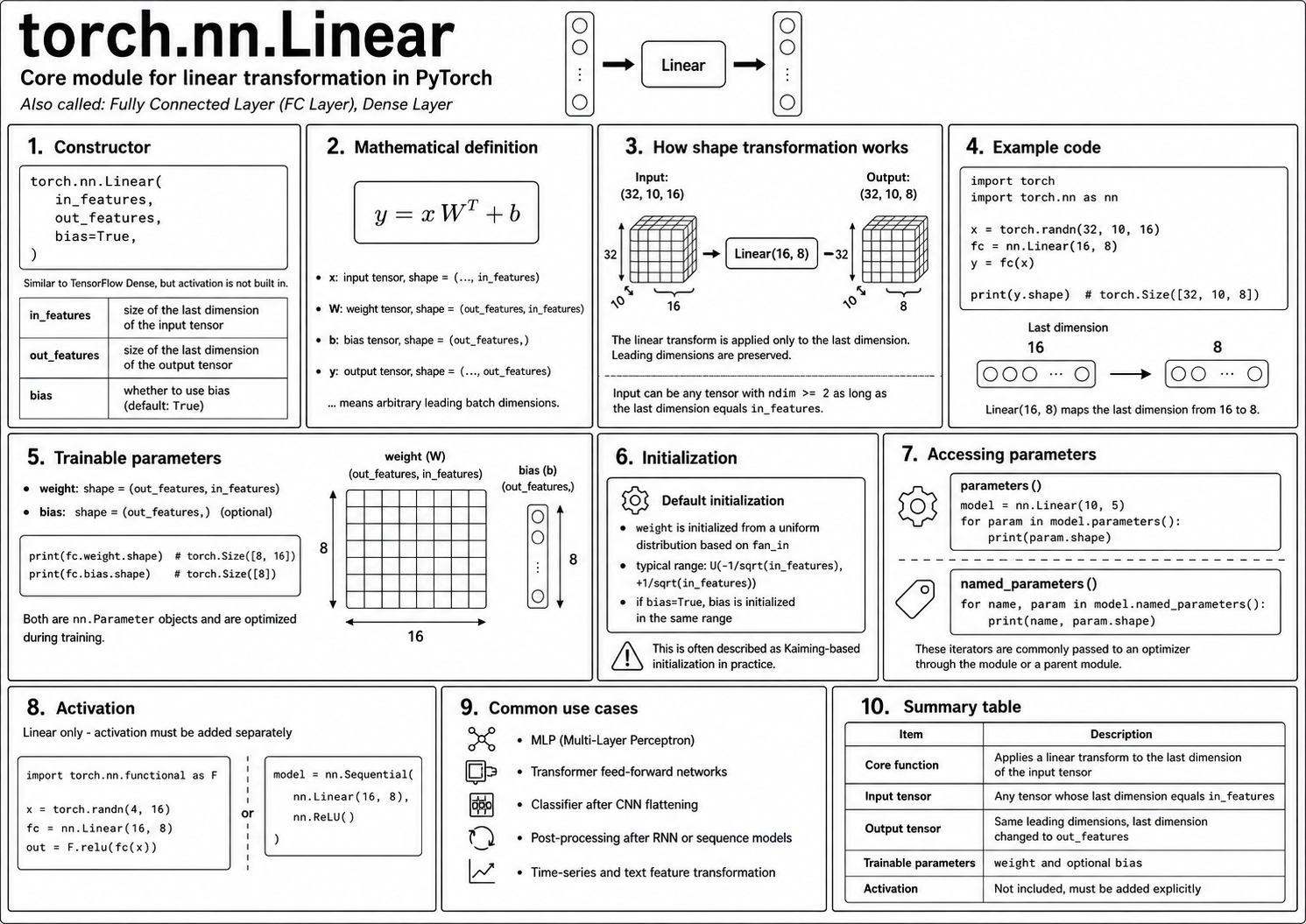
torch.nn.Linear는 PyTorch에서 선형 변환(linear transformation)을 수행하는 핵심 Module임.
다음의 이름으로도 불림.
- Fully Connected Layer (FC Layer)
- Dense Layer
Constructor (생성자)
torch.nn.Linear(
    in_features,
    out_features,
    bias=True,
)
- TensorFlow의 Dense와 유사하나, activation등을 내장하고 있지 않음.
| 파라미터 | 설명 |
in_features |
input tensor의 마지막 차원 크기 (int) |
out_features |
output tensor의 마지막 차원 크기 (int) |
bias |
bias 사용 여부 (기본값: True) |
수학적 정의
linear module은 다음의 연산을 수행:
$$\mathbf{y} = \mathbf{x} \mathbf{W}^\top + \mathbf{b}$$
- $\mathbf{x}$: input tensor, shape =
(..., in_features) - $\mathbf{W}$: weight tensor, shape =
(out_features, in_features) - $\mathbf{b}$: bias tensor, shape =
(out_features,) - $\mathbf{y}$: output tensor, shape =
(..., out_features)
여기서
...는 임의의 batch 구조로,
1개 이상의 앞차원을 가질 수 있음.
input tensor 는 2D 이상의 ndim 을 가지면 됨.
많은 경우, nn.Linear의 입력은 2D 텐서로 사용되나,
실제로는 마지막 차원이 in_features와 같고 2D 이상이면 input tensor로 사용가능함.
Example:
import torch
import torch.nn as nn

x = torch.randn(32, 10, 16)  # 배치 32, 시퀀스 길이 10, feature 16
fc = nn.Linear(16, 8)
y = fc(x)

print(y.shape)  # torch.Size([32, 10, 8])
위 예제 코드에서 linear transform은 마지막 차원(16에서 8로 변환)에 대해서만 적용됨
나머지 앞 차원(32,10)은 유지됨.
Parameters (trainable)
weight: shape =(out_features, in_features)bias: shape =(out_features,)(optional)
앞서의 예제 코드를 이어서 다음을 확인할 수 있음.
print(fc.weight.shape)  # torch.Size([8, 16])
print(fc.bias.shape)    # torch.Size([8])
- 이들은 모두
nn.Parameter객체 - 이들이 속한 module 객체 또는 해당 module객체를 attribute로 가지는 부모 module 객체의 parameters() 메서드를 사용하여,
optim객체에 넘겨져 학습됨. weight의 경우 Kaiming initialization에 기반을 둔 초기화가 기본적으로 이루어짐: $\mathcal{U}\left( - \frac{1}{\sqrt{\text{feature_in}}}, + \frac{1}{\sqrt{\text{feature_in}}} \right)$bias도 <codebias=True 인 경우에weight과 마찬가지로 방식으로 초기화 됨.
2024.04.11 - [Python] - [PyTorch] torch.nn.init
[PyTorch] torch.nn.init
torch.nn.init 모듈 ANN을 구현할 때, 각 layer의 weight 와 bias를 초기화하는 방법을 제공함. 초기화는 ANN의 수렴 속도 및 학습 안정화에 매우 큰 영향을 줌. torch.nn.init는 일반적으로 사용되는 다양한 초
ds31x.tistory.com
nn.Linear는 nn.Module의 subclass이기 때문에, nn.Module.parameters()를 통해 내부의 학습가능한 parameters들에 대한 iterator를 다음과 같은 방식으로 얻을 수 있음.
일반적인 Module에서의 parameters확인하기.
import torch.nn as nn

model = nn.Linear(10, 5)

for param in model.parameters():
    print(param.shape)
parameter의 이름과 값을 함께 얻고 싶을 때엔 nn.Module.named_parameters()를 이용하면 됨.
(name, parameter)쌍의 tuple 을 차례로 생성하는 generator를 반환함.
for name, param in model.named_parameters():
    print(name, param.shape)
2024.04.12 - [Python] - [PyTorch] Custom Model 과 torch.nn.Module의 메서드들.
[PyTorch] Custom Model 과 torch.nn.Module의 메서드들.
Custom Model 만들기0. nn.Module torch.nn.Module은 PyTorch에서 모든 신경망 모델과 계층의 기반이 되는 클래스임.Custom Model (사용자 정의 모델)부터 Built-in Layer(nn.Linear, nn.Conv2d, etc.)까지 전부 nn.Module을 상속
ds31x.tistory.com
Activation Function과 연결
Linear는 Linear Transform 만 수행하므로, 비선형성을 위한 Activation은 따로 명시적으로 추가해야 함.
import torch.nn.functional as F

x = torch.randn(4, 16)
fc = nn.Linear(16, 8)
out = F.relu(fc(x))  # Linear + ReLU
또는 nn.Sequential로 구조화 가능:
model = nn.Sequential(
    nn.Linear(16, 8),
    nn.ReLU()
)
다양한 활용 예
- MLP (Multi Layer Perceptron)
- Transformer 모델의 Feed-Forward Network
- CNN의 flatten 이후 classifier
- 시계열 데이터/문자열 처리 (RNN 후 처리)
Summary
| 항목 | 설명 |
| 핵심 기능 | 입력 tensor의 마지막 차원에 linear transform 적용 |
| input tensor | 마지막 차원의 크기가 in_features 인 텐서 (2D 이상 가능) |
| output tensor | 마지막 차원을 제외할 경우 input tensor와 동일한 차원 유지. 마지막 차원의 크기만 in_features에서 out_features로 변경 |
| parameters (trainable) | weight, bias (옵션) |
| activation | 지원하지 않음. 추가적으로 연결하여 사용해야 함 (ReLU, Sigmoid 등) |
같이보면 좋은 자료들
Linear — PyTorch 2.6 documentation
Shortcuts
pytorch.org
Welcome to PyTorch Tutorials — PyTorch Tutorials 2.6.0+cu124 documentation
Shortcuts
pytorch.org
2024.04.12 - [Python] - [PyTorch] CustomANN Example: From Celsius to Fahrenheit
[PyTorch] CustomANN Example: From Celsius to Fahrenheit
Optional Libraries torchviz: 0.0.2 torchsummary: 1.5.1 pip install --quiet torchviz pip install torchsummary Required Libraries torch : 2.2.1+cu121 np : 1.25.2 import numpy as np import torch import matplotlib.pyplot as plt # import torchviz, torchsummary
ds31x.tistory.com
https://dsaint31.me/mkdocs_site/ML/ch10/dl_linear_reg_torch/#10-torchnnlinear-model-pytorch
BME
autograd gradient descent linear regression mse optimization pytorch PyTorch로 직접 구현해보는 Linear Regression 1. Linear Regression의 기본 개념 Linear Regression은 입력 \(x\) 와 출력 \(y\) 사이의 관계를 linear transform 으로
dsaint31.me
'Python' 카테고리의 다른 글
| [Py] import 의 종류. (0) | 2025.04.18 |
|---|---|
| [DL] PyTorch-Hook (0) | 2025.04.10 |
| [PyTorch] torch.save 와 torch.load - tensor 위주 (0) | 2025.04.08 |
| [Py] 연습문제-carriage return + time.sleep (0) | 2025.04.07 |
| [OpenCV] macOS에서 Qt 지원하도록 빌드. (0) | 2025.04.05 |


